European Certified Mini Tracked Machines: The Guide to Adherence
European Certified Mini Tracked Machines: The Guide to Adherence
Blog Article
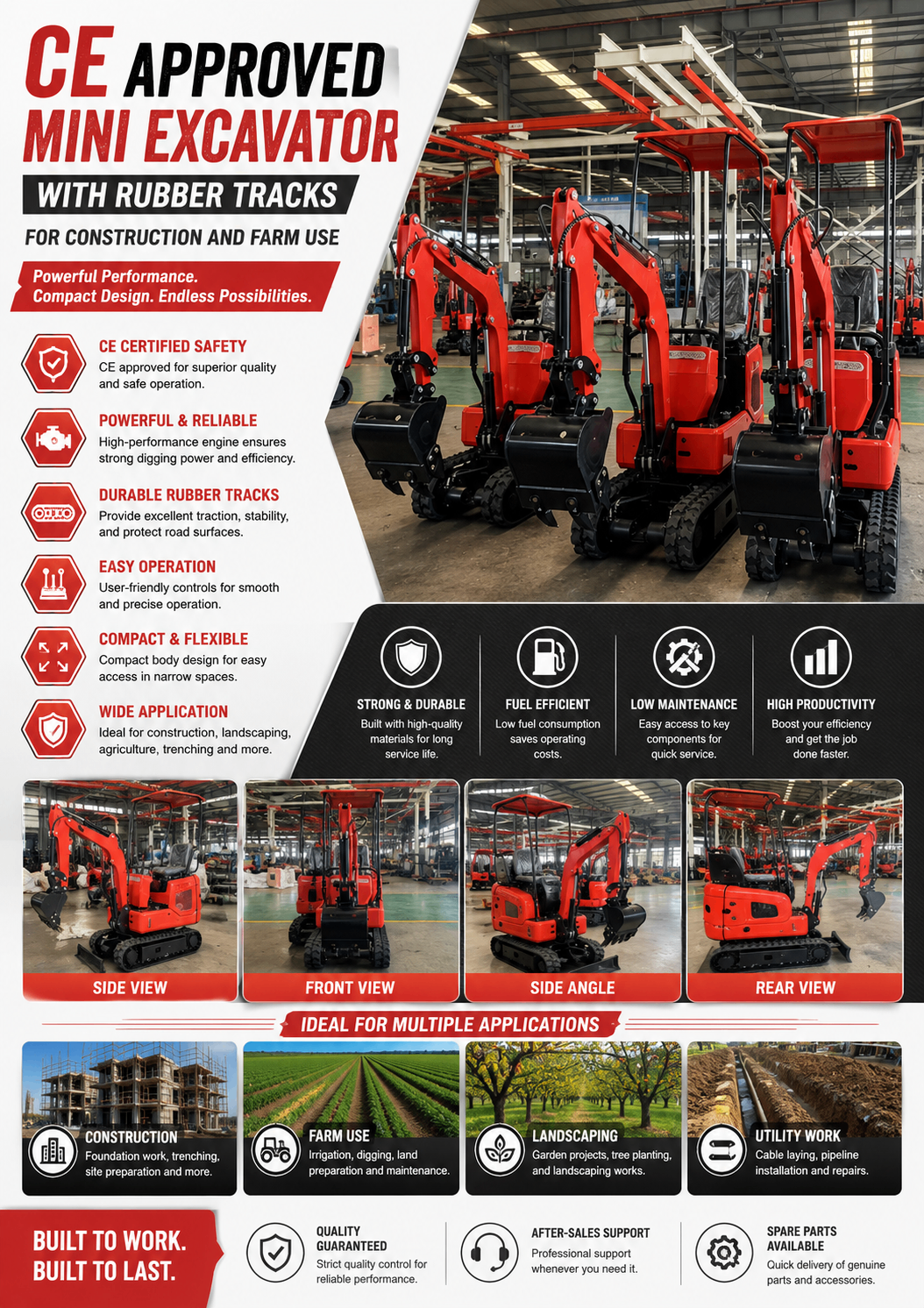
Ensuring your small machine meets European approval requirements is crucial for sales within the EU. These handbook details the necessary aspects of European certification for small tracked machines, including directives related to safety, construction equipment evaluation, and documentation. Understanding the rules enables companies to correctly operate their machinery and circumvent potential penalties.
Steel Track Mini Excavators: Excellent Traction for Tough Landscape
Mini machines Mini hydraulic excavator equipped with composite tracks are transforming how contractors handle projects in rough environments. Unlike traditional tire-equipped models, these flexible machines offer superior grip on slippery surfaces like gravel, slush, and uneven hills. This greater balance allows operators to complete tasks securely and efficiently, reducing downtime and increasing output. The yielding nature of composite tracks also lessens ground pressure, preserving delicate surfaces and minimizing environmental impact.
Compact Excavators: Significant Output in Limited Building Locations
These capable smaller excavators provide a notable answer for tasks where traditional equipment easily operate. Their smaller footprint enables access to challenging areas, including underground systems or within established structures. Despite their dimensions, they possess impressive excavating ability and accuracy, allowing them suitable for a wide scope of construction applications. Ultimately, small excavators symbolize a smart tool for contractors facing the difficulties of cramped areas.
Small Diggers for Farms : Versatility and Productivity in Agricultural Tasks
Modern farming operations often require tools that can handle a variety of challenging jobs. Mini excavators are quickly becoming invaluable assets for growers , offering exceptional flexibility and performance across a broad array of agricultural tasks . From trenching for irrigation networks and drainage to moving ground for constructing fences or levels , these pieces of equipment provide a robust solution. They even excel at removing land for cultivation, smoothing acreage , and managing resources with simplicity . Their reduced size allows them to work in restricted spaces that larger tractors simply cannot access .
- Digging for Irrigation
- Moving Soil
- Removing Land for Planting
Determining the Appropriate Mini Digger for Construction vs. Farm Uses
When considering a mini machine, it's critical to understand the significant differences between site projects and farm tasks . Construction sites often demand increased strength , precision , and the capability to operate in small locations. Therefore , a robust model with a extensive range of attachments might be best . On the other hand, agricultural land frequently involve less digging depths , more ground grading , and the need for small equipment to traverse pastures . Ultimately , detailed assessment of the anticipated workload is essential for making the suitable choice .
- Evaluate excavation distances .
- Evaluate the area limitations .
- Evaluate the needed tools .
- Factor in transportation difficulties .
{CE Marking & Mini Excavators : What Operators Require to Be Aware Of
Ensuring your {mini digger is compliant relevant European regulations is crucial, and that's where {CE certification comes in . This symbol demonstrates that the equipment has been assessed and meets health requirements, allowing free movement within the European Economic Area . {For owners of these machines, understanding CE labeling is essential . It isn't simply about having a mark on the excavator ; it represents a assessment of manufacturing and functionality.
- Check the presence of the CE label .
- Review the conformity document – this details the standards the machine meets.
- Consider that CE labeling is the manufacturer’s responsibility – though operators must be aware of its significance.